The problem
You’ve signed up for enough mailing lists to know the letdown of a generic follow-up. Building your own list, you don’t want to be that sender.
But hand-picking a response for every submission doesn’t scale past a handful a day, and a generic reply is exactly the letdown you’re trying not to hand someone else. The goal is a system that reads each submission and routes it correctly the instant someone hits submit, with no one checking a queue.be that sender. But hand-picking a response for every submission doesn’t scale past a handful a day.
The approach
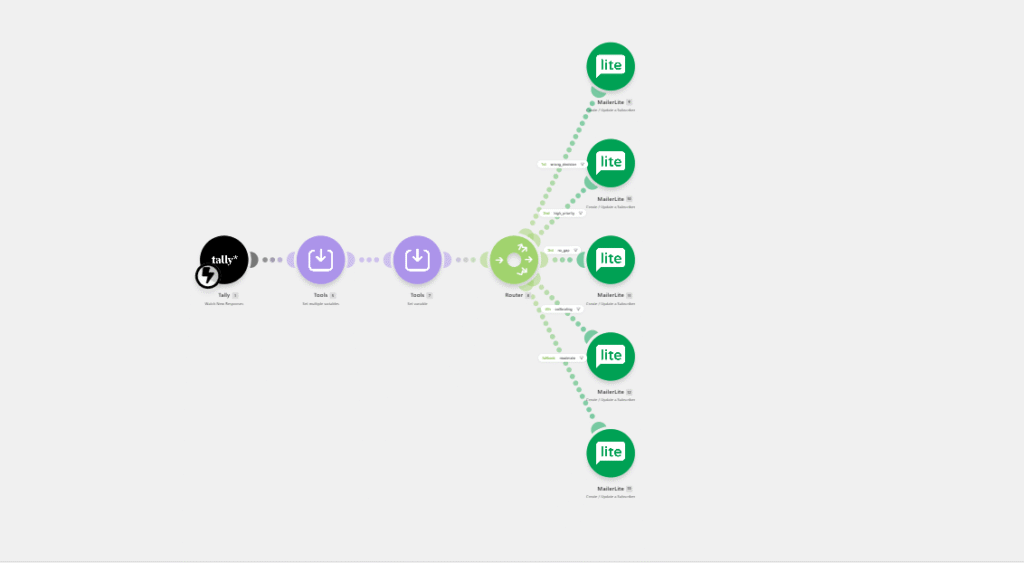
The core move is a single computed variable that runs a waterfall: picture a stack of gates, one under the other, in a fixed order. Each submission drops through the stack and stops the moment it hits a gate that’s open for it, never reaching the gates below.
Six boolean signals, built from the raw form answers, feed that waterfall. Rules run in priority order and the first match wins, sorting every submission into one of five segments before a person ever sees it.
How does the Make.com Lead Classifier route leads without anyone checking a queue?
The Make.com Lead Classifier runs a single computed variable through a priority-ordered waterfall: six boolean signals from a Tally form, tested first-match-wins across six rules. Each submission is stored fully in MailerLite before it routes, so a misfiring branch downstream never costs the lead’s data. Each of five outcomes triggers its own email track automatically.
How it works
Six steps run automatically, start to finish:
- A Tally form captures the raw signals: an override checkbox, whether the decision involves something they actually care about, how long they’ve sat with it, and whether they’d give someone else clear advice.
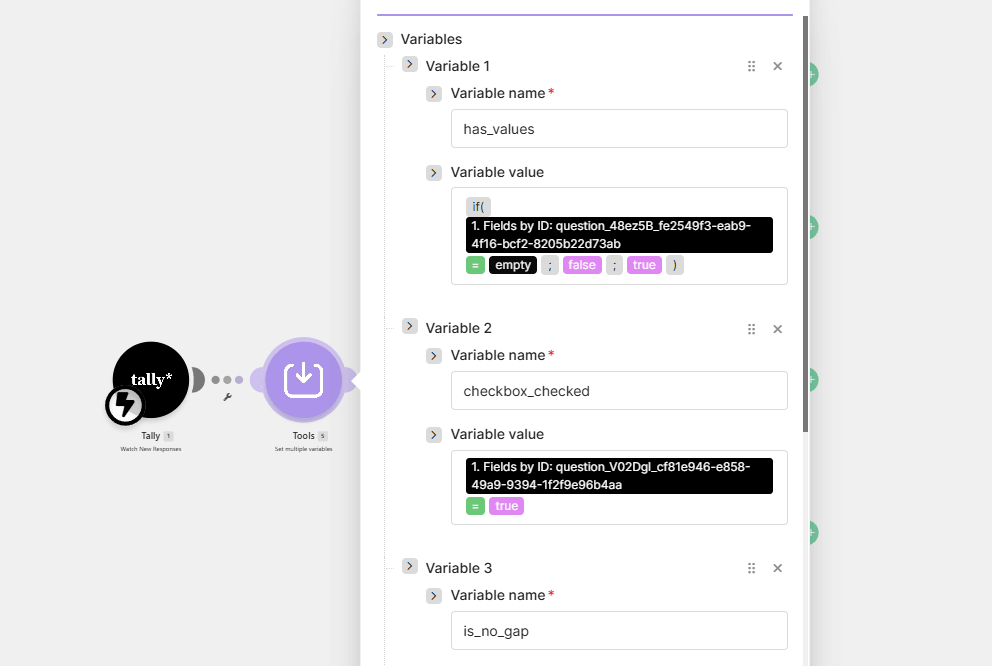
- Six boolean variables get computed from those answers, then feed the waterfall. The override check runs first, so an acknowledged, long-standing pattern never falls through to a weaker gate below it.
- The waterfall runs six rules, first match wins. An acknowledged, long-standing pattern outranks everything below it. An empty values field routes to a different track entirely, a signal of the wrong kind of decision for this funnel.
- The subscriber record is created and fully populated in MailerLite before anything routes. Store first, route second, so a misfiring branch downstream never costs the lead’s data.
- A router filters on the computed classification variable, five branches wide. Only one route should ever pass per submission; the waterfall already decided which.
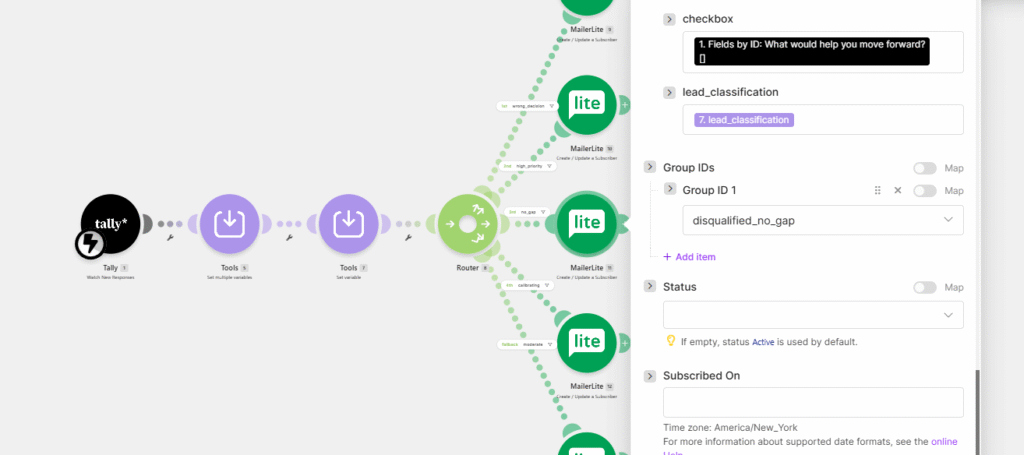
- Each outcome maps to its own MailerLite group, and each group triggers its own email track, no manual triage between submission and send.
Design decisions
- Gate order is the actual logic. The override check has to run before the pattern checks, or an acknowledged, long-standing pattern falls through to a weaker bucket that never gets it a second look.
- Filters reference the computed variable, not a literal string. Filtering on the text “classification” instead of its value makes every route silently fail, and a router with zero passing branches looks fine until you check.
- Type coercion on the checkbox. Tally returns a boolean; MailerLite’s custom field expects text. Fixed with an explicit boolean-to-text conversion at the mapping layer.
- Shipped with a full test matrix. One deliberately crafted submission per classification, verified end to end from the computed class through to the rendered email.
What this demonstrates
This is rules-based classification and reliable routing in a no-code environment: the same decomposition, priority logic, type handling, and end-to-end testing a scripted integration needs, delivered on a platform a non-engineering team can maintain.
Using this, you can build the same waterfall pattern into anything that has to sort an incoming stream into the right bucket without a human checking a queue: support ticket triage, application screening, any intake form standing between a submission and the right next step.
This routing logic picks up right after Lead Magnet AI, the conversational agent that generates the leads it sorts.
Common questions
What happens if the routing logic fails partway through?
Nothing is lost. The subscriber record is created and fully populated in MailerLite before anything routes, so a misfiring branch downstream never costs the lead’s data.
How was the classifier tested before it went live?
With a full test matrix: one deliberately crafted submission per classification, verified end to end from the computed class through to the rendered email.