The problem
The funnel this replaced was a seven-question static form. You answer, you get sorted into a bucket behind the scenes, and the payoff, if there is one, arrives later in an email you may or may not open.
You give real information and get nothing back in the moment. The invitation that follows feels unearned, because nothing has actually happened yet.
The goal: give you something real inside the session itself, so that by the time an invitation shows up, you’ve already felt the value.
The approach
Every stuck decision gets sorted behind one of two doors before anything else happens: real information you’re missing, or permission you haven’t given yourself.
That two-door split, information versus permission, is the diagnostic running underneath the whole conversation, something you experience directly, not something that happens behind a submit button.
One Claude agent runs the staged conversation. You don’t feel classified. You feel read.
How does Lead Magnet AI replace a static lead form with a real conversation?
Lead Magnet AI replaces a seven-question static form with one live conversation. Over seven stages and eight to twelve minutes, it captures your decision, runs a two-door diagnostic (information you’re missing or permission you haven’t given yourself), then generates a four-to-six-sentence personalized insight, quoting your exact decision and naming a reusable pattern, before any invitation appears.
How it works
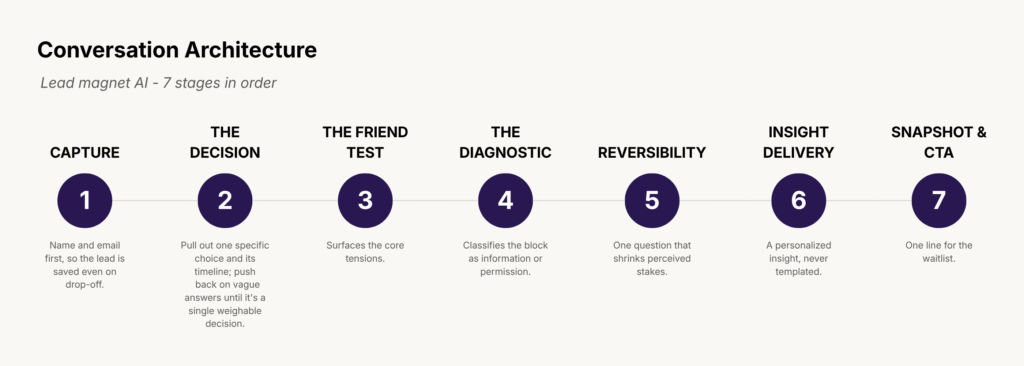
Seven stages, eight to twelve messages, eight to twelve minutes:
- Capture. Name and email come first, so your lead is saved even if you drop off before the end.
- The decision. The agent pulls out one specific choice and its timeline, pushing back on vague answers like “my career.”
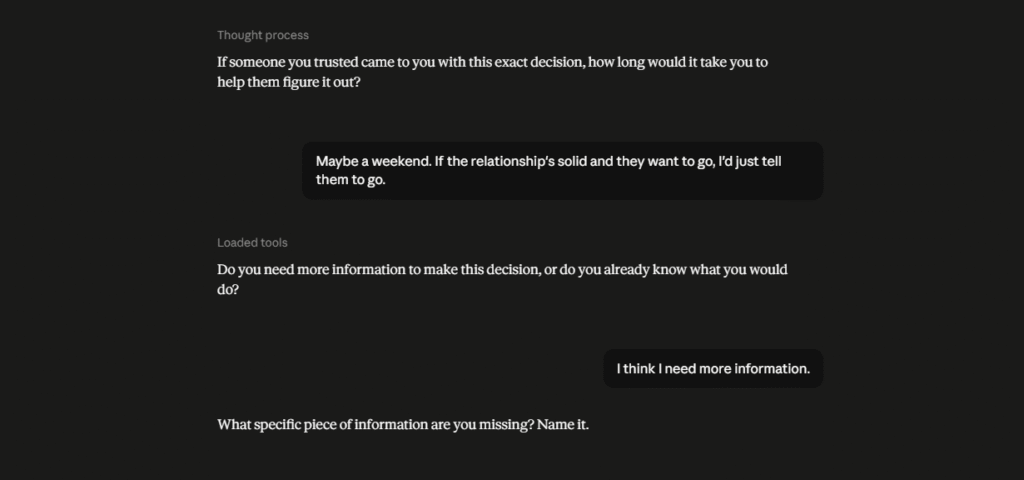
- The friend test. You’re asked what you’d tell a friend stuck in the same spot, an answer that comes faster than the one you’d give yourself. The agent lets you feel that gap instead of pointing at it.
- The diagnostic. The two doors open here: information, a fact you’re missing, or permission, something you already know but haven’t owned. Watch for the disguise, a permission problem wearing a research excuse, a “fake information gap,” moved through the right door.
- Reversibility. One grounding question shrinks the stakes by naming the actual worst case out loud.
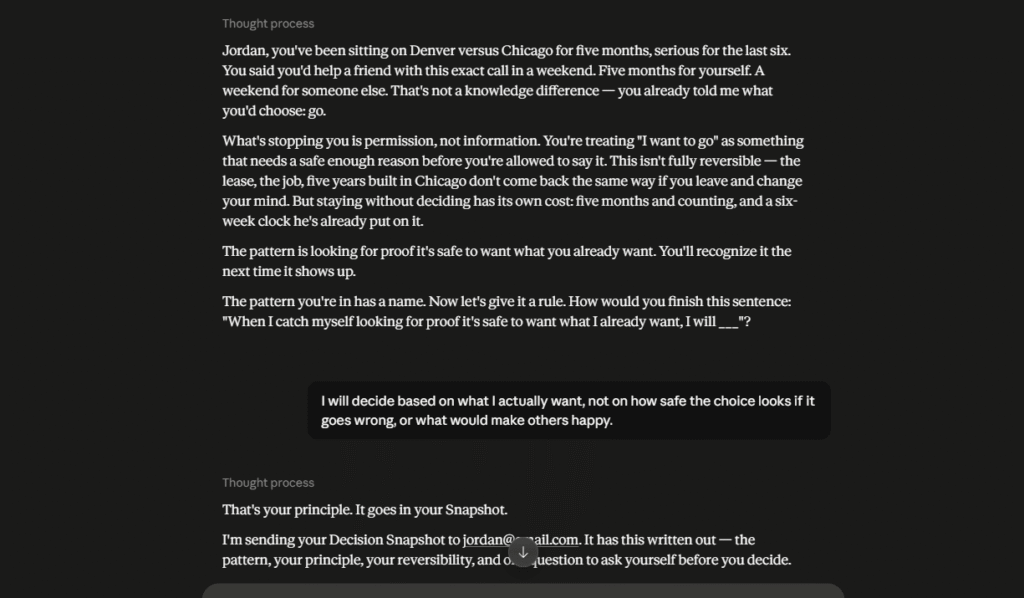
- Insight delivery. A four-to-six-sentence, personalized summary in your own words: your decision, your block, your friend-test answer, whether it’s reversible, and a reusable pattern name. Specific enough that people screenshot it.
- Snapshot and CTA. One line inviting you to the waitlist, no price, no pitch, plus a snapshot email to keep.
Design decisions worth noting
- The insight is generated, never templated. A weak version says “trust yourself more.” The prompt must quote your exact decision, name your specific fear, and close with a reusable pattern label, a quality bar that’s tested, not assumed.
Restraint is designed in. Several stages tell the agent not to comment, rush, or explain: the tension, the recognition, and the relief are what make the session land. It steps back exactly when filling the silence would be tempting.
What this demonstrates
This is end-to-end AI product design, not a wrapper around a chat box. It’s conversation and prompt architecture, a two-door classification handled entirely inside natural dialogue instead of a form, and output-quality constraints tested against a real bar.
The build ties it all together: an LLM API, an automation platform, an email system, and a website working as one flow.
Using this, you can build the same pattern into anything that currently asks someone to fill out a form and wait: an intake flow, a qualification funnel, an onboarding sequence.
Anywhere the real job is sorting someone through one of two doors, and giving them something back before they leave the room.
Full architecture and integration detail in the GitHub case study.
The same two-door diagnostic carries into Decision Clarity, rebuilt as a standalone skill anyone can run; Make.com Lead Classifier picks up the routing problem this build’s insight creates.
Common questions
Has Lead Magnet AI been deployed?
No. It’s designed and architected end to end, but not yet deployed. The case study is tagged “Designed,” not “Shipped.”
What happens to the lead’s information if they leave partway through the conversation?
Name and email are captured in stage one, before the diagnostic or insight stages run, so the lead is saved even if someone drops off before the conversation finishes.